|
|
来源:市场资讯
(来源:经济管理学刊)
本期文章
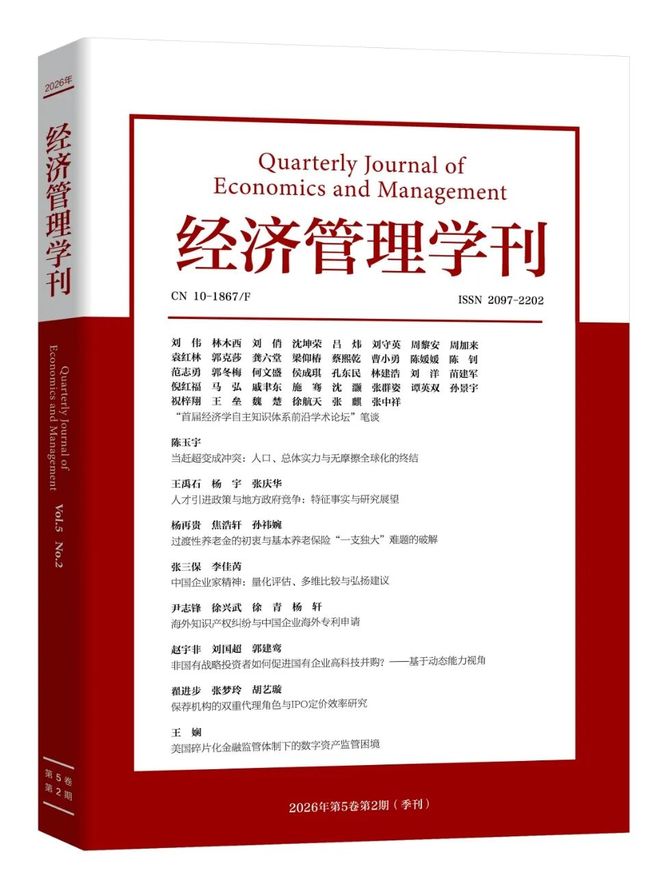
保荐机构的双重代理角色与IPO定价效率研究
Research on Dual Agency Behavior of Sponsoring Institutions and IPO Pricing Efficiency
【原文刊载在《经济管理学刊》2026年第5卷第2期】(2026年6月出版)
作者
翟进步、 张梦玲、 胡艺璇, 中央财经大学财政税务学院
Jinbu Zhai, Mengling Zhang, Yixuan Hu (School of Public Finance and Taxation, Central University of Finance and Economics)
摘要
注册制背景下的保荐机构跟投制度能否使企业的首次公开募股(IPO)定价趋向公允呢?本文选取2019—2025年在科创板上市的571家企业作为研究样本,聚焦保荐承销商兼具证券“卖方”与“买方”的双重身份属性,探讨了由此产生的双重代理问题对IPO定价效率的影响。研究发现,虽然跟投制度加剧了保荐承销商的代理冲突,但在利润最大化目标的驱动下,对该代理问题的权衡及内部互斥和约束力量的动态均衡,最终会促使企业IPO的估值和定价向更公允的方向发展。具体而言,衡量保荐机构承接IPO项目整体利润的初始净收入(承销费用减去跟投成本)显著提高了IPO定价效率,投资者的意见分歧是作用机制,具体表现为提高网下报价标准差和降低首日换手率。此外,初始净收入对IPO定价效率的提升作用在承销商声誉高、分析师关注度高、投资者关注度低的样本中更显著。最后,本文的研究证实保荐承销商的双重代理角色带来的博弈一定程度上能够提升IPO定价效率,但投资者需要注意警惕跟投期间“托市”行为引发的上市公司短期价值虚高风险,监管层应进一步完善相关制度建设,充分发挥跟投期间保荐机构作为重要治理力量对上市公司经营质量的提升作用。
关键词
关键词:跟投制度;保荐机构;双重代理问题;IPO定价
Keywords:Follow-on Investment System; Sponsoring Institutions; Dual Agency Problem; IPO Pricing
内容精要
一、研究背景与意义
中国的注册制改革采用了“试点先行、先增量后存量、逐步推开”的科学路径,从科创板试点到全面实行,逐步走深走实。科创板率先实行市场化定价机制,通过询价方式确定发行价格,同时配套保荐承销机制进行发行管理,监管部门将不再直接参与IPO质量审核,信息披露的真实性更多依靠发行企业内控和保荐机构等中介机构的履责和督导。为压实中介机构责任,科创板出台了保荐承销商跟投制度,规定要求保荐机构使用自有资金参与上市公司的认购,其跟投比例为2%~5%,锁定期为24个月。在跟投制度下,保荐承销商作为股票“买方”有动机压低IPO定价以降低投资成本和破发风险;而作为“卖方”又有动机抬高定价以获取更高的承销费。双重角色的特殊性带来复杂的双重代理问题,使承销商在拔高与压低价格中进行博弈以寻得利益的均衡。作为一项重要配套制度,其能否让作为独立第三方的中介机构在保荐过程中发挥应有的作用呢?本文围绕科创板企业IPO估值和定价这一重要问题,基于保荐承销商既作为“卖方”又作为“买方”的双重角色及其所面临的双重代理问题这一视角,研究科创板跟投制度下保荐承销商的利益平衡与IPO定价效率之间的关系。
二、主要内容
IPO市场信息不对称问题严重(Rock,1986),已有研究表明,券商可以利用相关专业知识与信息优势缓解发行人和投资者之间的信息不对称情况(Booth andSmith,1986)。尽管理论上承销商应该以“发行价值贴近企业内在价值”为目标协助发行人进行上市准备,但作为追求利益最大化的理性主体,承销商可能会通过多种利己性炒作策略扰乱IPO定价,从而扭曲首日发行回报(Cliffand Denis,2004;Loughran and Ritter,2004;Liu and Ritter,2010;Dambra et al.,2018)。
在跟投制度下,真实的现金投入在具有信息优势的中介机构与具有信息劣势的投资者之间形成了一定的利益绑定,降低了保荐承销商抬高发行价的机会主义动机(张岩和吴芳,2021;曹奥臣和张铁钢,2022),有效抑制了未来的股价崩盘风险(李一哥等,2025)。现有研究虽有考虑保荐承销商的双重身份,但实际上对保荐机构跟投制度的研究主要从投资者情绪、承销商声誉和跟投意愿或强度等方面展开,对保荐承销商仍通过“单一身份”进行考量,这为本文研究提供了新的切入点。本文的关注重点主要基于跟投制度下保荐承销商获得的综合利益,并从保荐承销商既作为证券“卖方”又作为“买方”的双重角色出发,对其双重代理问题及其后续影响展开研究。
三、主要结论与政策建议
本文以2019年7月至2025年5月的科创板上市公司数据作为研究样本,通过对保荐机构双重角色下的利益博弈进行分析,以保荐承销商的初始净收入(承销费用减去跟投成本)来衡量其代理行为的均衡选择程度,并以此为基础研究其对IPO定价效率的影响。
研究发现,保荐承销商的初始净收入越高,IPO定价越趋向合理,IPO定价效率越高。这意味着,在跟投制度下,保荐承销商在IPO定价时既要越高又要越低才能对自己越有利的矛盾纠结中,使得保荐承销商的机会主义行为动机减弱,IPO定价受到的非市场性干扰减少,最终迫使IPO定价趋向公允价值。该结果使用保荐机构过去一年承销的非科创板IPO项目平均承销费率计算的初始净收入作为工具变量、更换IPO定价效率衡量指标后依然成立。
在机制检验上,本文发现高初始净收入激励承销商在定价策略上采取更加积极和灵活的态度,使其在IPO定价过程中能够更加主动地权衡不同利益之间的冲突,降低投资者和发行人之间的信息不对称程度,使IPO定价更具公允性。具体表现为高初始净收入促使承销商充分传递真实信息,有效打破了一级市场询价机构“抱团压价”的虚假共识以合理提高报价差异,进而从源头上压缩套利空间,引导二级市场预期收敛以降低首日换手率。
异质性分析结果表明,初始净收入对IPO定价效率的提升作用在承销商声誉高、分析师关注度高、投资者关注度低的样本中更显著,这表明声誉带来的道德约束与分析师的外部信息挖掘有助于强化跟投制度的正向促进作用,而散户投资者过高的非理性关注和情绪扰动则会逆转为“价格压力”,抑制定价效率的提升。在进一步研究方面,本文基于新股市场表现的视角探讨了IPO定价的市场化效应。研究证实,保荐承销商的双重代理角色带来的博弈在短期内可以提升企业的持有期超额收益率,但其驱动作用会随着时间的推移和市场动态的复杂化而逐渐弱化,这提示投资者需警惕跟投期间因保荐机构“托市”行为引发的上市公司短期价值虚高风险。
四、研究贡献
与现有研究相比,本文的边际贡献在于,不同于以往的单向评估框架,本文以保荐承销商兼具保荐人与投资人的双重身份为切入点,全面考量了双重代理角色在行为冲突和平衡下对新股定价效率的影响。同时,本文将初始净收入作为利益权衡的关键点,较为全面地考虑了双重代理角色在行为冲突和利益平衡下对IPO定价效率的影响,从理性经济人角度出发,在理论与微观数据上肯定了这种特殊双重代理行为下保荐机构在IPO定价中的公允性,为理解注册制深化改革下中介机构的微观治理效用提供了全新的理论视角与实证支撑,丰富了跟投制度对新股定价影响的相关研究。
Summary
China's registration-based IPO reform adopted a scientific path. The strategy was “piloting first, reforming new sectors before existing ones, and rolling out gradually.” It started as a pilot on the STAR Market. The reform is now fully implemented. This process has deepened steadily. The STAR Market adopts a market-oriented pricing mechanism. It determines the issue price through inquiry. It also uses a sponsoring and underwriting mechanism for issuance management. Regulatory authorities no longer directly audit IPO quality. Information authenticity relies heavily on intermediary supervision. This includes internal controls by issuers and due diligence by sponsors. To consolidate intermediary responsibilities, the STAR Market innovatively introduced the co-investment system. This rule requires sponsors to use their own funds to subscribe to listed companies' shares. The co-investment ratio is between 2% and 5%. It also has a 24-month lock-up period. However, existing literature mainly studies this system from specific aspects. These include investor sentiment, underwriter reputation, and willingness to co-invest. Theoretical discussions still mostly view sponsors through a “single identity”. Previous studies evaluate the policy primarily from a “buyer” perspective. They fail to comprehensively consider the sponsor's simultaneous role as a securities “seller”. This single-perspective limitation provides a new starting point for our study. It leads to our core research question. Can the co-investment system drive IPO pricing toward fair value under the registration-based regime? Under this system, sponsors take on an additional role as stock “buyers”. As “buyers”, they have strong motives to lower IPO prices. A lower price reduces initial investment costs and lowers the risk of falling below the issue price. Furthermore, it offers potential investment gains from a post-IPO price surge. As “sellers”, they have strong motives to raise IPO prices. A higher price secures higher underwriting fees and maximizes current profits. The dual role creates a complex dual agency problem. It forces underwriters to balance between raising and lowering prices. They do this to find an equilibrium of interests.
To answer this question, we select 571 companies listed on the STAR Market from July 2019 to May 2025 as our sample. We focus on the dual identity of sponsors as both “sellers” and “buyers”. We explore how this dual agency problem affects IPO pricing efficiency. In our research design, we adopt the perspective of a “rational economic agent”. We theoretically analyze the interest game under this dual role. We innovatively use the sponsors' initial net income to measure their equilibrium choice. This metric is the difference between underwriting fees and co-investment costs. We accurately measure pricing efficiency using the absolute log deviation between the first-day closing price and the average offline institutional bid. Based on this measure, we test its causal impact on IPO pricing efficiency.
Our research finds that the co-investment system exacerbates agency conflicts. However, the drive for profit maximization creates a dynamic equilibrium of internal constraints. This ultimately guides IPO valuation and pricing toward fair value. Specifically, a higher initial net income leads to higher IPO pricing efficiency. Sponsors face a contradiction of wanting both high and low prices. This contradiction weakens their opportunistic motives. It reduces non-market interference and makes IPO pricing more reasonable. In the mechanism tests, investor opinion divergence is the core transmission path. This manifests as a higher standard deviation of offline bids and a lower first-day turnover rate. A high initial net income prompts underwriters to transmit true information. This effectively breaks the false consensus of “collusive underpricing” among primary market institutions. It reasonably increases bid differences. Consequently, it compresses arbitrage space from the source. This guides secondary market expectations to converge and reduces the first-day turnover rate. Regarding heterogeneity, the enhancement effect is more significant in certain samples. These include firms with high lead underwriter reputation, high analyst attention, and low investor attention. This shows that reputation constraints and analyst supervision play a positive reinforcing role. Conversely, excessive irrational attention from retail investors creates “price pressure”. This hinders the improvement of pricing efficiency. In further research, we explore the market-oriented effects of IPO pricing. We confirm that the dual agency game can increase holding-period excess returns in the short term. However, this driving effect weakens over time due to complex market dynamics. Investors should beware of short-term overvaluation risks. These risks arise from “price support” behaviors by sponsors during the co-investment period.
Compared to existing research, our marginal contribution breaks the previous unidirectional evaluation framework. We use the sponsors' dual identity as a starting point. We comprehensively consider the impact of the dual agency role on IPO pricing efficiency. Additionally, we innovatively use initial net income as the key metric for interest trade-offs. We theoretically and empirically affirm the pricing fairness of sponsors under this special dual agency behavior. This provides a new theoretical perspective and empirical support for understanding the micro-governance utility of intermediaries under the reform. It greatly enriches the literature on the co-investment system and IPO pricing.
原文引用:翟进步, 张梦玲, 胡艺璇. 保荐机构的双重代理角色与IPO定价效率研究[J]. 经济管理学刊, 2026, 5(2): 261-282. |
|



 窥视卡
窥视卡 雷达卡
雷达卡 发表于 2026-9-2 17:26:42
 提升卡
提升卡 置顶卡
置顶卡 沉默卡
沉默卡 喧嚣卡
喧嚣卡 变色卡
变色卡 千斤顶
千斤顶 照妖镜
照妖镜